Refugee and newcomer youth may be particularly vulnerable to trafficking at various points in their lives: in their countries of origin, during their migration journey, and after arrival in the United States.
To better understand this risk, it is important to first define what human trafficking is.
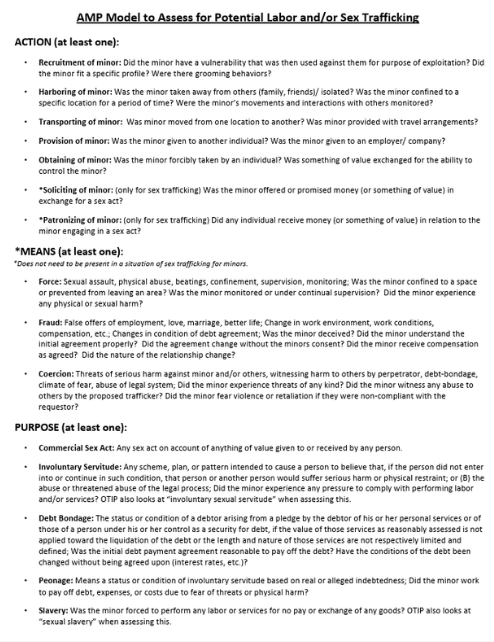
Under U.S. federal law (22 U.S.C. § 7102), “severe forms of trafficking in persons” includes both sex trafficking and labor trafficking:
Sex trafficking is the recruitment, harboring, transportation, provision, obtaining, patronizing, or soliciting of a person for the purposes of a commercial sex act, in which the commercial sex act is induced by force, fraud, or coercion, or in which the person induced to perform such an act has not attained 18 years of age.
Labor trafficking is the recruitment, harboring, transportation, provision, or obtaining of a person for labor or services, through the use of force, fraud, or coercion for the purposes of subjection to involuntary servitude, peonage, debt bondage, or slavery.
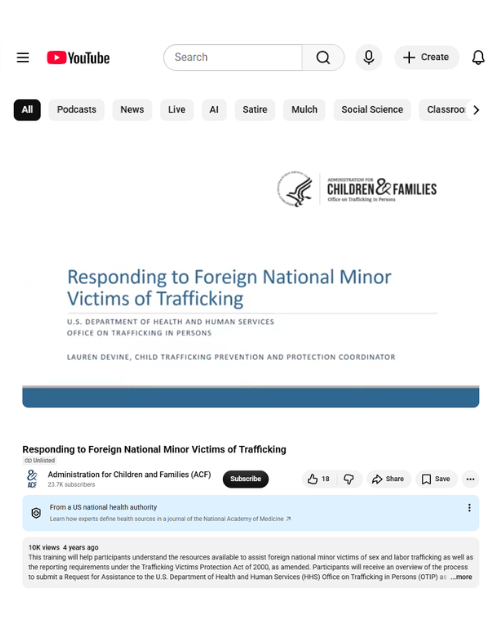
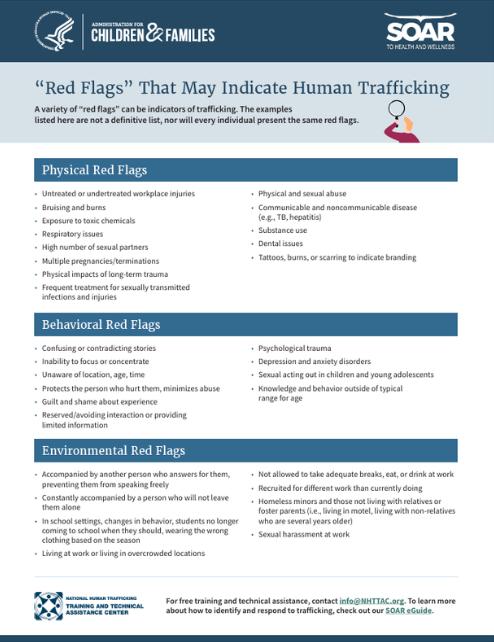
The resources in this section will help providers better understand what human trafficking is and the supports available to refugee and newcomer youth.